Friday, October 30, 2015

A vocation of care

image from here

This is one of my favourite poems by Dr Seuss. It's so hilarious and has since live in my head for as long as I can remember.

We go about doing our things every day and thus I regard the everyday as an accumulation of moments. Everyday seems mundane, repetitive and relatively predictable.

The modern lifestyle, overstimulate and tired our nerves. Indeed, why else would we seek new experiences? After all, if our primary aim is hedonism, would you mind plugging in to philosopher Robert Nozick's Experience Machine as described in his book Anarchy, State, and Utopia in 1974.

What is deemed unique to me would be typical by my neighbour, what is accidental appears as normal if it happens often enough and what is superficial and fleeting could be an essential and basic. We experience change slowly especially when we have established our personal routines in our daily lives (consider the hand that's holding your toothbrush, you don't think about which hand to use every time you brush your teeth). We accept the oddities in our world, without noticing how strange they can be. We watch with amazement at the Khoisan click language, but they communicate just like how we do with ours.

In 'sociological aesthetics' (Simmel, 1968), la vie quotidienne (everyday life) is open to aesthetic attention by connecting it with the social totality. "To involve ourselves deeply and lovingly with even the most common product, which, would be banal and repulsive in its isolated appearance, enables us to conceive of it, too, as a ray and image of the formal unity of all things from which beauty and meaning flows" (Simmel, 1968:69). To study the everyday, the concept of analysing the most common object is necessary to learn about the interactions between fragments and the environment. Examining the microscopy of common events is an interesting way to see what's extraordinary in the ordinary.


Simmel, G. (1968). The conflict in modern culture and other essays, translated by K. Peter Etzkorn, NY: Teachers College Press.

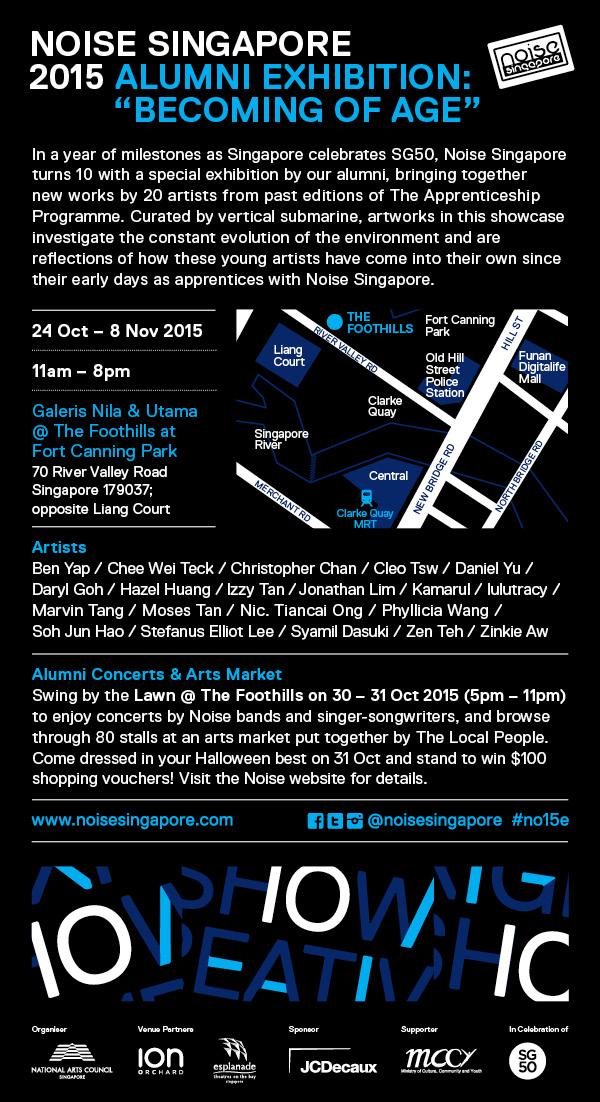
Sunday, October 18, 2015

NOISE ALUMNI EXHIBITION: “BECOMING OF AGE”


Friday, October 2, 2015

From Spaces to Places

The rhetoric of competitiveness, of discipline and efficiency is framed by the idea of speed. The idea of slowness such as slow living, slow food or slow juicer seems to be getting popular which very much contrast with the ideal image of an effective multi taskers and the demand for higher network speed. I'm looking at how space is defined at home and how it influences our lifestyles.

The relationship that constitutes a family can be define by the layout of the home. In Singapore, HDBs mean that family members are used to live in close proximity with each other. We are far removed from natural environments. Rather than living amidst nature and open spaces, we are glued to the idiot box.

To have a garden at home is considered a luxury, it could mean you own a private land for gardening when others have to worry about their shoe racks causing obstruction in the corridor. Or unless you are lucky enough to live on the ground floor of HDB that allows you to do larger-scale gardening (see images below), also in pots, but in higher quantity. 

The garden, is there for aesthetic reasons, as means of providing food or an escape from everyday stress. A personal expression, an outlet for creativity or act as a symbol for power. The garden could be a product of people's power over nature and of power in society. For example, Sun King's Versailles is a symbol for his greatness. The land at Versailles was reshaped between 1661 and 1700 to make way for an estate that would assert the power of Louis XIV's monarchy and showcase the Sun, a symbol that he chose as self representative. His garden design reflected the dominant philosophical ideas of the time, namely the thinking of Descartes and his assertion of humans as "master and possessor of nature" (Harrison. 2008, p. 113).


I avoid going out during the weekends if possible. The crowd, the constant hustle and bustle, the smell of sweaty bodies mess up my mind. I can't think, all I wanted to do is to get away from these to home. We are adapted to sharing interior spaces filled with bright lights, noise, moving images and people so much that when suddenly being immersed in nature seems 'exotic'.

Living here after being cushioned with comforts in contemporary life may not be an easy transition. 

Harrison, R. P. (2008). Gardens: An essay on human condition. USA: The University of Chicago Press.

Thursday, September 10, 2015

Invitation to Seed Exchange & Garden Party

Hi there!

Please join us on a Sunday of art making and learning about the environment!

Seed Exchange & Garden Party invites gardening enthusiasts and novices to join us on an art and garden expedition. We’ll discuss the relations between art and the environment, utilise organic materials in art making and doing some gardening. This is a kid-friendly event. Pets are welcome!
Venue: Pulau Ubin
Date: 27 Sept 2015 (Sunday)
Time: 10am – 2pm
Free admission (excluding boat ride)

To participate, please register for the event HERE.
If you would like to be updated of future events, please leave your particulars HERE.
 E-poster credit: Amanina Zaini

Invited artists Eunice Lim and Riko (Feeza) will be joining us for a relaxing and creative Sunday! J


About the artists

Eunice Lim (b 1992), a Singapore based visual artist, has always been intrigued with human relationships and narratives in culture. She translates her studies with mediums her ideas discern most appropriate for. Also, she is extensively involved in community arts and collaborative projects with various organisations and partners. 

Eunice's works has been featured in various press & media platforms. She has also exhibited both locally and internationally. These comprise venues such as Singapore Art Museum @ 8Q (Singapore), The Arts House (Singapore), Angel Orensanz Foundation of Contemporary Art (New York) and Sabanci University (Turkey).

理子 (Riko) is a Singaporean artist who uses art as a platform to explore her identity and identities. Coming from a mixed heritage - Indian, Japanese and Malay - the artist seeks secrets and hopes to discover new understandings within each identity she is expected to assume as well as identities that crosses path and complicates her very existence. 理子 started out as a photographer and the Editor-in-Chief of an alternative culture zine called Prosaic Magazine in 2003. Currently, she is busy with the development of several works in progress such as the Talksickseries, Collecting Time, Crotch Photography. Some of the companies and galleries that 理子 has done works for includes Nike, Singapore Art Museum, Wheelock Art Gallery, Forth Gallery and Finale Art Gallery, Manila. 

Monday, August 3, 2015

Binary oppositions

As Eliot writes, we "arrive where we started/ and know the place for the first time." As much as Singaporeans are well-travelled, a majority of my friends, including myself live and work here for most of our lives. How do we see a place so familiar to us with a fresh perspective? We travel. We reside in a new place for a period of time. We speak to the locals. And explore places outside the tourist terrains. We look at areas at the extreme ends of some issues, hoping to derive solutions in the process.

Binary oppositions often occur in artists' areas of interest or rather it has been deployed to structure the world. For example, order/ disorder, home/ house, conceal/ reveal, public/ private, life/ death etc. In literature, similar concept is seen, in the Science fiction novel Strange Case of Dr. Jekyll and Mr. Hyde written by Robert Louis Stevenson. Yes, sometimes, certain words do not have an opposite such as a word for "The opposite of loneliness" book, by Marina Keegan.

Niels Bohr, the Nobel Prize-winning physicist said, "the opposite of a true statement is a false statement, but the opposite of a profound truth can be another profound truth." Perhaps we are to view the world as a concept of paradox. Rather than splitting the world into either-ors, we could see them as both-and. To discover the truth, we could embrace those opposites as one. Liken breathing itself as a form of paradox, using inhaling and exhaling to be whole.

T. S. Eliot, "Little Gidding," in T. S. Eliot: The complete poems and plays, 1909 - 1950 (Orlando, Fla.: Harcourt Brace, 1958), p. 145.  

Saturday, July 4, 2015

Viewing art

Most of the people I know personally are my non-art friends. They are categorised as "non-art" because they didn't receive any formal art training. But of course, this could lead to a conversation if one is to say that everyone is an artist. They could take an interest in art because they treat art like a hobby or something to do to past time or simply because they knew me. Whenever we visit the museums/art exhibitions, they would ask for my interpretation or the intention of the work. But, who can acclaim a know-it-all, sometimes I don't even know the artist's existence prior to the visit. 

Shahn (1949) wrote that "art is the creation of human value". In viewing art, we can ground our understanding by discerning its diverse contextual qualities besides the formal and thematic qualities. It's essential to understand that artists consider three areas that contribute to the integrity of a work of art. Though I won't speak for all artists and obviously art making may not be a linear process. These considerations will help viewers to create/ respond to art that is authentic, deep and meaningful. It's also a tool to get closer to understanding art and making connections to life.

Sandell (2006) revealed the following equation: Art = Form + Theme + Context(s). Form is about how the work is. Perhaps all art students would receive education about the formal approach such as the art elements and principles of design. When we examine theme,it's what the work is about. The artist address the big/ enduring idea. Along with the relationships that reveal the artist's perspective connecting art to life. Finally, when we investigate context(s),we look at when, where, by/ for whom and why the art was created and valued. Most probably, there's a significance and relevance to society and the viewers. 

Most of the time, art work speaks more than what is presented in the synopsis hung beside it or the collateral that accompanies it. Works in an exhibition setting may be presented out-of-context. With contextual information, viewers can perceive the intention and purpose of an artwork by identifying person, social, cultural, historical, artistic, educational, political, spiritual and other contexts that influence the creation and understanding of the work. Thus, it's important that viewers read or research more about the artist/ artwork that is presented to them because they may lack the contextual, cultural or historical knowledge that is generally required before the subject and content of images can be grasped. 

It can be frustrating when artists are unwilling to explain further about their work. Sometimes for a reason. For example, Australian aboriginal artists have refused to disclose the meaning of all their symbols to outsiders in order to preserve some of their tribal cultural secret. Nonetheless, there are artists who may choose not to reveal more of their work for some reasons. 

Sandell, R. (2006, January). Form+Theme+Context: Balancing considerations for meaningful art learning. Art Education, 59(1), 33-37. 

Shahn, B. (1949, November). Ben Shahn. Magazine of Art 42.

Tuesday, June 9, 2015

Home/ House

Living without water nor electricity is almost unheard of in Singapore. Convenience in a modern home is taken for granted. For the first-timer house buyer, one would expect to see new furnishings, home appliances, sound system or a well-equipped kitchen. The proud owners often took to social media to broadcast the development of their new nest (making sure that the brand of the new purchase is not cropped out in the photo). The living condition here in today's standards would perhaps give the impression that one is living in poverty. But is the "modern home" a luxury? The prevalence of purchasing commodities with interest-free instalment plans spur us to consume more than necessary, working harder and longer hours than ever to maintain our lifestyles.

The curse of narcissism meant that we look more outwardly than ever. To be judged as a fully-functioning member of the society, besides adhering to social norms , our identity depends much on the things we have, the people we know, our attire, the function we attend etc.

Soon, this will be my temporary home, friends are likely to take a keen interest for the sight of kampong house are long forgotten and more prominent in images. We have forgotten how to live simply, instead it has become a chore or a burden to fuss over obtaining basic needs.